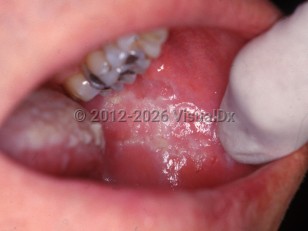
Chronic cheek chewing, also known as morsicatio buccarum, is a common condition that is seen in patients who chew or nibble on the mucosal lining of the mouth, often as a nervous and unconscious habit. There are similar variants for chronic cheek chewing of the tongue (morsicatio linguarum) and lip (morsicatio labiorum). The pathophysiology involves repetitive mechanical trauma to the buccal mucosa leading to hyperkeratinization. In most cases, the patient uses their canine teeth to crush the superficial layers of the surface oral epithelium, leading to chronic injury.
Morsicatio buccarum most commonly occurs in the third to sixth decades of life, but it is a condition characterized by limited epidemiological data due to underreporting and underdiagnosing. Chronic cheek chewing is present in up to 60% of patients with temporomandibular disorders. The Diagnostic and Statistical Manual of Mental Disorders, Fifth Edition (DSM-5) classifies morsicatio buccarum as an obsessive-compulsive related disorder. Risk factors include psychological stress and other impulse-control related psychiatric conditions. Additionally, there is literature supporting a cyclical variant of morsicatio buccarum related to premenstrual syndrome. Premenstrual fluid retention can cause cheek swelling which, when combined with stress-related bruxism, can lead to the development of cyclic cheek lesions.
Chronic cheek chewing is usually asymptomatic.
Related topic: oral frictional hyperkeratosis
Chronic cheek chewing - Oral Mucosal Lesion
Alerts and Notices
Important News & Links
Synopsis

Codes
ICD10CM:
K13.1 – Cheek and lip biting
SNOMEDCT:
59901004 – Cheek chewing
K13.1 – Cheek and lip biting
SNOMEDCT:
59901004 – Cheek chewing
Look For
Subscription Required
Diagnostic Pearls
Subscription Required
Differential Diagnosis & Pitfalls

To perform a comparison, select diagnoses from the classic differential
Subscription Required
Best Tests
Subscription Required
Management Pearls
Subscription Required
Therapy
Subscription Required
References
Subscription Required
Last Reviewed:03/09/2026
Last Updated:03/25/2026
Last Updated:03/25/2026
Chronic cheek chewing - Oral Mucosal Lesion